Showing posts with label Turkey. Show all posts

Thursday, March 31, 2011

Ankara, 2nd site: Atatürk’s mausoleum

We had just arrived at the airport in Ankara and Murat picked us up and asked if we wanted to go to the hotel, or to go see something. What the heck, let's go see something. So where are we going? Someplace special was the reply. When we arrived and parked the car, it was not at all apparent where we were, or why anyone would go where we were headed. But we followed Murat through the security, that seemed tight at the time, but which we would learn was nothing unusual by Turkish standards. We headed up the hill and slowly it revealed itself.

It has a name (Anitkabir) but what it is, is the final resting place of MK Atatürk. As you know, Atatürk is revered in Turkey in a way that few leaders anywhere are revered. You cannot walk far in a Turkish city without passing a statue in his honor. So, what is his mausoleum like?

I always thought Napoleon’s tomb was a bit on the excessive side, but then my hero is Thomas Jefferson and I always was impressed by the restraint shown in his marker (not even the biggest in his family's cemetery). Restraint was not shown with Anitkabir. The mausoleum itself is just one part of a sprawling complex set on a hill overlooking Ankara. One gets the feeling that Atatürk's place is there, watching over his country and his capital, even in death.

Anitkabir was not Atatürk's first resting Place. The complex was the product of an elaborate process of design and construction and not completed until 15 years after Atatürk’s death. It was not built just for him. It is also a monument to his achievement, the Turkish republic. It is their ceremonial space, featuring dramatic monumental architecture and massive open spaces to be filled on ceremonial and patriotic locations. And Atatürk is at its center. Makes perfect sense to me.

Wednesday, March 30, 2011

Turkey: History Atatürk by Andrew Mango

Is democracy possible in a Muslim society? It is a burning question in this time of the ‘Arab 1848’. The reference to 1848 is a reference to the year that revolution swept across Europe. There does seem to be a demonstration effect to revolution. It happens in one place (Tunisia) and people elsewhere ask, why not here? And so in the last days we have watched Muslim societies tear down their existing regimes. It begs the question: what will they build in their place? If you asked people in the squares, they would likely tell you they want a democracy.  And we are back to the original question: is democracy possible in a Muslim country?

That may sound like a silly or bigoted question. Silly, because there are some notable examples of Muslim democracy - Turkey and Indonesia, for example.  And bigoted because the revolutions we are witnessing testify to Muslims desire for democracy. But wanting something and keeping it are not the same thing. Desire alone is not enough. Democracy is not a natural state of human affairs. Creating it, sustaining it, takes work.

As soon as I had decided that I would be visiting Turkey, I knew that I wanted to read a biography of Atatürk.  Atatürk created Turkey.  What is today a relatively stable and prosperous state goes in no small measure to the will of a single man, Mustafa Kemal Atatürk.

Turks seem to understand this. I think it is what explains Atatürk’s ubiquitous presence 70 years after his death. It's not just the statues, though there are lots of them. His picture is everywhere - stores, restaurants, government buildings, homes, car windows, flags almost anywhere you can imagine an image, someone has an image of Atatürk there. I wonder if Stalin, even at the height of his cult of personality was as omnipresent. When Stalin died, he disappeared. Atatürk remains. His story and Turkeys must be remarkable.

So I looked for a book that would tell those stories. Ideally it would have been written by a Turk, someone with the perspective that can only be gained by living it. Alas that was not to be. Turks do write books about Atatürk - lots of them. They don't translate them, it seems. Outside of Turkey the interest in Atatürk is not so great. Mango’s book was a good compromise. Mango was born and raised (to age 21) in Turkey. He experienced Atatürk’s Turkey firsthand. It is still a western outsider’s perspective, but it is one who fully understands the society he is observing. As such he does a good job of helping the reader understand Atatürk managed what was nothing short of a cultural Revolution. There are those (ok, me) who would argue that that was his greatest accomplishment.

Turkey under Atatürk was never a democracy. What Atatürk did was set Turkey on a path towards the creation of a society that could eventually become and sustain democracy. Many of the Turks I met are very worried about the future and the political dominance of Islamists. These are legitimate fears and to the extent that Islamism grows it grows at the expense of Atatürk's legacy. It would be a counter-revolution and a threat to the democracy Turkey has become.

That's why all those images of Atatürk make me optimistic. It is not so much a glorification of him, but of his ideals. Those ideals are modern, progressive, secular and democratic. A country with those ideals will tend to be democratic. Turkey is still populated by Muslims but it is not an Islamic democracy - just a democracy where most citizens practice Islam. There's a difference and they have Atatürk to thank for it.

Turkey: Tour guide, Frommer’s

Having now read a whole bunch of tour guides, I am beginning to look at them collectively in a different light. For me, their main purpose is to provide background, detail and then guidance as I plan my trip. And they do that, but they are also like the menu at a restaurant. They list all the possibilities and then you choose what you will have. But have you ever thought about the menu in reverse? Mostly it is a list of things you could have, but won’t. Guide books are beginning to depress me. They are lists of places I could visit, but won't.

For Turkey, I used Frommer’s, probably the most mainstream of all the many possibilities. Of the countries I have visited so far Turkey is the one about which I knew the least, going in. Some guidebooks target a niche.  Being quirky is their sales point. That works if the guide is adding to what you already know about a place. For me, knowing so little, I needed thorough and comprehensive. Frommer’s delivers.

The guide book describes six different regions, any of which would merit extended exploration. Given the nature of my project. It was kind of like Frommer was teasing me. Ankara, the capital, was a given and for the second city, Istanbul was the obvious choice. So that's it? No, that was impossible. We’d be missing so much. Turkey is such a large, diverse and beautiful country, two cities would not be enough. But then the question is: of the other four, which three do you leave out? We settled on Izmir and the opportunity to see the Aegean Coast and Ephesus, the ancient Greek ruins. I think it was a good choice but I can't help wondering about Bursa and Cappadocia and all the other things we missed.

Tuesday, March 29, 2011

Turkey: Youth, education.

In many respects, education was the raison d'être of Atatürk’s revolution. Establishing Turkey’s independence and securing Turkish territorial integrity were clearly vital impulses motivating the Turkish nationalists after World War I, but accomplishing those goals did not require a revolution. The revolution was not just political, motivated by Atatürk’s desire to be in charge. No, Atatürk wanted to be in charge in order to accomplish a revolution - a cultural Revolution. Atatürk believed the long-term success of Turkey depended on a cultural transformation from Eastern (Ottoman) tradition to Western “civilized” modernity. Turkey’s competition was Europe and they were outperforming them. Atatürk believed Turkey’s old ways were holding the country back and he was determined to shed them.

Bilkent's Gate
Education was the means for social transformation and had the notable side benefit of creating a constituency supportive of the policies going forward. As a result education and Turkey’s youth had a special place in the heart of Turkey’s unquestioned leader. They figure prominently in his rhetoric and mythology. Given the extraordinary devotion of Turks to Atatürk, even to this day, his commitment to education remains a core value of Turkish society. Turks take education seriously and have created a system that compares favorably with its European neighbors.

K-12 education is compulsory and admission to the university is competitive. There is a single nationwide, three-hour exam which creates a hierarchy among students and allocates the most desired placements based on performance. On the surface this is an egalitarian merit-based system. The reality is that like in the United States, exam prep is vital and exam prep courses cost money. Do the wealthy have an advantage? Of course they do, but in Turkey that advantage ends at the university's gates.

Once you get in, the Turkish university student has a pretty sweet deal. Their education will cost them virtually nothing. Tuition is non-existent, housing and board are provided. At Bilkent University (Turkey’s #1 and that's not just according to Murat, a proud alumnus, Wikipedia agrees) students had at their disposal anything they could need. The campus is immense (5000 acres, Harvard in comparison is 210 acres) and is more like a city unto itself with stores, a hospital, its own mosque (and religious space for minorities) and associated business enterprises. It is the realization of Atatürk’s vision for his country. It turns out graduates who in global competition take a backseat to no one.

Turkey: Medical

Istanbul
Some federal judges in the United States believe that America's new health insurance regime is unconstitutional. In Turkey things are a little different. Turkey’s constitution guarantees its citizens ‘Social Security’ and explicitly charges the state with the responsibility to make it happen.

That power in the hands of the state does not set Turks off as it does so many Americans. They are used to an activist state that makes policy in many very important aspects of their life. There does not seem to be a Turkish Glenn Beck, with his hair on fire about how this is the first step down the path to dictatorship.

Upscale, Private
Turkey is going the other direction on that path. Today the Turkish state has a smaller footprint in Turks' lives than has been true at many points in its history, including especially the ‘glory days’ of the Atatürk era. So Turks are used to the government taking responsibility for healthcare, they expect it - I think they even like it.

So everything is just fine, then? Well, as always, the devil is in the details. As always with health care, the question is about quality and accessibility. Americans want top-quality and they want it on demand. They probably would not be happy with the Turkish public system. But then, significant numbers of Turks feel the same way it seems.

Bilkent University 'Clinic'
Reform of the system has been an important part of the ruling AKP's governing program. Consistent with their general approach, they are adding market elements to the system, reducing relatively the state's role.  According to the PM’s pre-election rhetoric, they aren't done yet. Has it improved healthcare for Turks? The people I asked seem to be okay with what they had, but there do seem to be growing differences between classes. Wealthier Turks and can afford extra payments and supplemental insurance and have access to better care. Is that good or bad? I don't know, but it is not unlike a lot of other countries.

Monday, March 28, 2011

Turkey Academic: Kesselman

In the CHP Cabinet Room
Finding a comparative politics text book that has a chapter on Turkey is more difficult than one might think. The book I currently use, Hauss’ Comparative Politics does not have a chapter, even in the online supplemental materials. The publisher of that text (Cengage) does have other comparative politics texts and one of them, Kesselman did have a chapter on Turkey among its online resources, written by a Turkish scholar Ersin Kalaycioglu. So that's what I read to provide the academic foundation for understanding Turkish politics.

The High Court Statues: Justice & Atatürk
I found one, so what's the big deal? Well, first, there are several approaches to the study of comparative politics; institutional & cultural, just to name the two most common. No matter which approach one takes, the SOP (standard operating procedure) is to take that approach and apply it to several countries. After doing that the patterns (similarities and differences) begin to appear and make sense.

Turkey is not one of the countries included by most authors in their set. To me this is a surprise considering the dearth of democracies where the dominant religion is Muslim and the importance of understanding the intersection of Islam and democracy to the United States, a country with its army in two such countries, trying to build a democracy and get out.

Local Political Party HQ
What this means to me is that the type of chapter I would want for my students - one with a focus on history and culture - does not appear to be available for Turkey. The Kesselman chapter I read does a good job setting out for students the context of Turkish politics (history and demographics) and provides an overview of key players (institutions) but does not explore what I think is the most interesting question: why Turkey is the way it is. Another issue with the chapter is that it appears to have been completed in 2004 - more than six years ago. A lot has happened in Turkey in the last six years. It is past time for an update.

This presents a dilemma. I would like to include Turkey as a formal part of my course, but how do you do it without appropriate reading material?

Saturday, March 26, 2011

Turkey, Novel. The New Life by Orhan Pamuk


I don't know if I had ever read a book by an author who has won the Nobel prize for literature until now. Orhan Pamuk won the prize in 2006 and the Wikipedia snippet from his Nobel announcement made him a perfect fit for the Turkish lit portion of this project: “Orhan Pamuk who in his quest for the melancholic soul of his native city has discovered new symbols for the clash and interlacing of cultures.” 

The ‘clash and interlacing of cultures’.  That really sums up the Turkey I experienced during my visit there. Many times, it seemed to me that the place I was visiting with more European than many places I had visited in Europe. But if you know anything about Turkey you also know there is a lot about the place that is simply not European and there are a lot of people that like it that way and to want to preserve and enhance those differences. There is both on interlacing and a clash.

I was interested to see how this would play out in literature. In that respect, ‘A New Life’ does not disappoint. The book is the story of a young man whose life is transformed by a book. He is a normal, everyday college student until one day he happens upon an intriguing woman who just happens to have a copy of ‘the book’. On his way home after their encounter, he happens on another copy of ‘the book’ and on an impulse, he buys it.  After reading it, the book and the vision it presents become an obsession. He dropped everything to pursue it - abandoning the old life and all that went with it.

Is it too much to say ‘the New Life’ is a metaphor for Modernity and the west? The old life being Turkey’s religious and traditional path? You’d have to read it your self to decide, but it did not seem like such a stretch to me. And in Pamuk’s clash of civilizations, who is the victor?  I couldn't say. The end is a little obscure.  Probably a Nobel Prize requirement.

Wednesday, March 16, 2011

Turkey, Cinema: Eyvah, Eyvah and Magnificent Century


Turks are a proud people - and it is not like they do not have a lot to be proud of. Still, it has struck me that there is a measure of insecurity in expressions of that pride. It has been a crime in Turkey to disparage Atatürk. Why? Are the manifestations of his greatness not enough to win the day against his detractors. He needs the police to silence them. Turks see his greatness, but seem sure others will not. And so he needs protection.

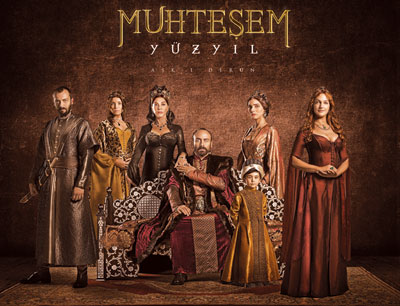
I felt the same thing experiencing Magnificent Century. I say experiencing, because, well - what we did was so much more than simply watching the presentation. Magnificent Century chronicles the reign of Suleiman (a.k.a. Suleiman the Magnificent) ruler of the Ottoman Empire for much of the 16th century. It is a season-long television series running in 24 parts.  We were not able (yet) to see it in its entirety. The opening episode (90 min.) is available with subtitles on YouTube.  The second episode we watched with Murat and his family at their home. They kindly provided simultaneous translation. The remaining episodes have been appearing online, but without subtitles - so really we only know how the saga begins…

And we know how it was received in Turkey when it was broadcast. The closest thing I can compare it to was ‘Roots’. Magnificent Century created a huge stir.  There were daily stories in the press. It got to the point where even the Prime Minister (Erdogan) felt compelled to condemn it.

What was wrong? I think it became a surrogate for the ongoing struggle between conservative and secular elements in Turkish society. Another front in the fight about ‘how good was the past’ and how much of that past should we include in national life. Magnificent Century was criticized for showing one of Turkey’s greats in a not entirely flattering light.  In Turkey that sparks a fight.

‘Eyvah, Eyvah’ was in contrast just a piece of fluff.   I chose it because while we were in Turkey it's sequel 

‘Eyvah, Eyvah 2’ seem to be the number one comedy playing in almost every Cineplex we passed. The original is always better and since ‘Eyvah, Eyvah 2’  is still not available with subtitles, the choice was easy.

The film is the story of a country boy who goes to the big city (Istanbul) in search of his long-lost biological father. Hilarity ensues. He gets mixed up with a lounge singer (way out of his league) and then sucked into some underworld intrigue. The happy ending has him headed home to his village, his family and his true love. Can't wait for them to translate the sequel. It was a very enjoyable film. Like a brief trip back to one of our favorite places.  The people and ambience were very familiar and pleasant. Two hours well spent.

Tuesday, March 1, 2011

Daily Periodical Review: Hurriyet. January 12-24, 2011

The thing about reading a newspaper every day is that if you read the same one, you have to wonder if what you are reading is in fact the news or just the news they want to report.

In Turkey I did not have much choice in selecting the paper I would read. It wasn't that there were not a bunch of different papers.  No, there were plenty of those.  It may not be an exaggeration to say that if I spoke Turkish I would have had dozens of choices. But then, I don't speak Turkish.  So on the newsstand every morning, among the many choices, I would look for that one English language daily - Hurriyet Daily News (HDN).

One of the things I noticed while sorting through the papers looking for the HDN was that they did not all have the same visual content. I do speak pictures and though I could not understand anything else on the front page, the sense I got from the pictures was that there was no consensus on what was ‘front page’ news.

The Suleiman Soap Opera
That's not a surprise. One of the reasons that there is such a diversity in the Turkish press is because many of the papers are mouthpieces for political parties. They have an official relationship, like Pravda or Fox News. And then, of course, they report with that slant.

So does the paper I read have a bias? I expect it does. To me it seemed to take the opposition (CHP) party’s view and reported on events that would resonate with people who shared those views. People with an anti-Islamist, secular, modernist perspective.

There were plenty of stories relating to issues of liberty. A minor controversy sprung up over a TV soap opera that fictionalizes the life of Sultan Suleiman the Magnificent. It portrayed him drinking and kicking back in the harem and apparently insulted Turkey’s ancestors in so doing. At least that is what the Deputy Prime Minister thought when he issued a cryptic warning about ‘retribution’ for those who humiliate important people from ‘our’ history. (I didn't know you could humiliate people dead for hundreds of years.) There were lots of similar stories; students being sued by the Prime Minister for a satire that ‘insulted’ him; A ‘freakish’ statue the government wants torn down; More seriously, 50 journalists in jail waiting trial for various offenses.

Together they are evidence of the serious concern secular Turks have about the AKP government and it's agenda to Islamicize the country - to impose their views and ways. Is that their goal? Time will tell. The AKP says it is not. They say that is exactly what the other side (Kemalists) has been doing for decades. They are just trying to give devout Muslims the freedom they have been long denied. They have a point. Atatürk did constrain liberty and impose a culture. The fear is that Islamists elsewhere (read Iran) have such a poor record of embracing liberty. Could these Islamists (AKP) actually be tolerant? If so that would be dramatic progress.  Secular Turks seem unwilling to take the chance. They see the AKP’s tolerance (so far) as a mask that will be worn just until power is consolidated.

It is an interesting drama to watch from the luxurious safety of a free country.

Museum, History: the Atatürk and War of Independence Museum

Atatürk's car
In the  Anitkabir complex, filling the massive structure built to frame the ceremonial square, is Turkeys museum of its critical moment in history, the War of Independence. Most countries (sometimes governments) have a museum like this, a place that expresses who they are and how they see themselves and the glorious things that they are capable of. It makes sense that in Turkey that museum would focus on Atatürk and the War for Independence.

Atatürk, Turkey and the War for Independence have a symbiotic relationship with each other. It is quite possible that if any one of those three did not exist, the other two might not exist either.

Atatürk leading the people
At the end of the First World War, the Ottoman Empire found itself on the wrong side of victory with the British, French, Greeks and Armenians all looking to grab a piece of an empire that was disappearing fast. And in fact, they all did. In its weakened state, the Sultan was unable to offer affective resistance. Who was looking out for the interests of the Turks? That is where Atatürk stepped up. The Sultan’s government in Istanbul was the prisoner of occupation forces. He could not fight back, so Atatürk would.

Atatürk created government in Ankara and from there conducted the War for Independence. It is part of the legend, the slaying of foreign giants. You can debate how hard it was to expel countries who did not really want to stay (UK and France) but the fact is that Atatürk won that war. He liberated Turkey and when he was done he dismissed the Sultan and created the Turkish Republic. Modern turkey was born.

Involving women in the revolution
The Museum memorializes and animates the crucial moments in making Atatürk who he was (the battle of Gallipoli for example) and chronicles how Atatürk made Turkey what it is (but does not allow pictures, sorry - snuck a few but it is much better than they show). After the creation of the Republic, Atatürk lead a cultural revolution. He sized up the competition (Europe) and concluded that for Turkey to be secure and prosperous, it needed to become more like the West, modern and secular. The museum highlights the principles Atatürk sought to realize - the importance of education, the equality of women, among others.

Some of Atatürk's reforms (there were many - from dress to language to religion) are still controversial to this day. The unabashed devotion on display in the museum and almost everywhere else in Turkey made me wonder why he is not more often used as a stick to beat political opponents. Kind of like the Tea Party uses our Founding Fathers to pillory Obama. That doesn't seem to happen yet with Atatürk. It seems he still belongs to everyone.

Friday, February 25, 2011

Turkey: Police

On Istiklal, on my favorite street, the police presence was stark. Istiklal is an avenue that runs from Taksim Square, past shops and embassies and past what may be Turkey's most prestigious school, Galatasaray, on its way to the terminus of the funicular that takes you up the big hill from the bridge to the old town. It is a happening place, jammed with pedestrians seemingly at all hours of the day.

With so many people, obviously some security presence is warranted. What we found, however, was a police presence much larger than that required for routine security. There is a section of Taksim Square that is reserved as a staging area for riot control squads whose numbers at times must exceed 100.

The area is always cordoned off and guarded. In the morning there may be just a bus or two, empty and parked. In the evening there might be seven or eight busses and dozens of police milling about. That begs the question, what are they doing there?

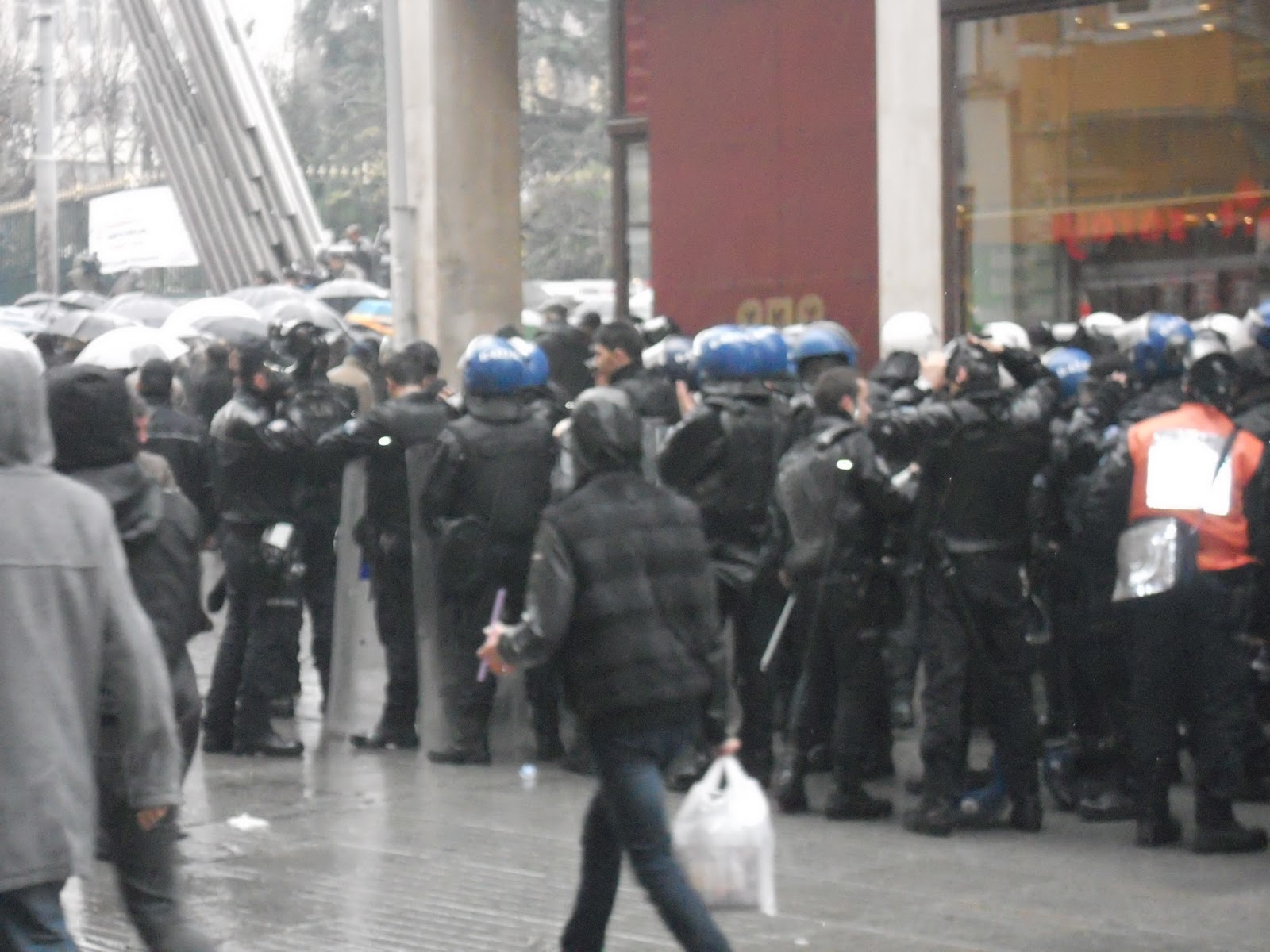
Well, it seems that the gates and square in front of Galatasaray are a magnet for protesters. In our short stay in Istanbul (seven days) we must have walked up and down Istiklal a dozen times at various hours of the day and night. On three of those occasions, we encountered organized protests of one kind or another. Lots of less organized leafleting. Once, we saw the police force actually deployed.

As we strolled up Istiklal, approaching Galatasaray, the flow up the street started to slow. We soon saw why. Three to four dozen police were there with their equipment (protest tanks – a kind of APC – and water cannon) They were observing a demonstration and obviously preparing for conflict. They had their shields and body armor and were beginning to fit on the gas masks. As it was only 100 yards for us to sneak by the protest, I asked if it was safe to pass. The answer was no - we should go around. So we did. A couple of blocks up, a couple blocks over, a couple of blocks back and we were back on Istiklal, on the other side. There we found a similar cadre of police, boxing the protesters in. We waited, watched, ready to flee. Nothing happened. We waited, still nothing. Finally we moved on. I asked at the hotel the next day if there had been some excitement on Istiklal. No one had heard a thing. It seems nothing had happened.

We encountered the same scene in Ankara. Police suiting up. Nothing happened. It seems it is all part of a script. Protesters come out -because that's what protesters do. The police come out as if to say we are ready for trouble - if you want to make it. The protesters don't want trouble, so they don't make it. Everybody plays their role and goes home.

WiT? Clue:  The palm tree in the background says Cuba.  It seems they don't do statues of living people in Cuba.  (I saw none of Fidel, for ex)  It being Cuba, that means Castro likes him, must mean the US didn't.  And No, our government of the day really did not like this guy.  He got what we wanted for Fidel.

Blog Note:  I still have some posts for Turkey, but we will shift to Cuba for the next few, then come back in a week or so and finish up the Turkey posts.

Turkey: Cultural


Not the best pictures, it was dark.  It's a bar!
Obviously, in any society, there is a range of cultural forms that together comprise what might be called a country's culture, or cultural heritage. I am reminded of a French joke I once heard about America: “You know why they have yogurt in America, don't you?” “No, why?” “Without yogurt, there would be no culture!”

Okay, so we are not big on opera. But still, we do have culture. Rap music is a cultural form, and it is ours. The point is that not all culture is high culture and that low culture is also an important form of expression. A long justification of my choice for Turkey. We thought about the ‘Whirling Dervishes’ as  representative of Turkish culture, but as impressive as they are, they are like the Amish in America. They exist, they are interesting, but they are not America. The Dervish are not Turkey.
The beer street

What is? I was impressed by what I experienced one evening as we went looking for a beer. Now you know Turkey is a Muslim culture and you probably think you know that Muslims don't drink. So finding a beer might be a challenge, right? Wrong. Turks do not observe what might be described as a more fundamentalist restriction on alcohol. It seems they never have. Turkey is a Muslim country with a national drink – Raki - and a country that makes some pretty good beers. Finding one was not a problem. In fact, in Ankara there was a whole street with nothing but bars. We had our pick and we picked the student bar.


Inside, the place was jammed with students, men and women, drinking and smoking (despite a nominal prohibition – it seems the rule is just don't get caught) and listening to a folksinger performing on stage. It was a scene that could have been found in any student hangout in Berlin or Berkeley. What struck me the most was the equality of men and women. Not everywhere in Turkey did I feel that men and women were equals and their roles could easily be reversed. But here among the educated younger generation that seemed to be the case. The conversations, the interactions, the behaviors did not seem to be gender influenced. The place was very modern.  To me it was a very encouraging sign, if you prefer a Turkey that is secular and democratic. 

Wednesday, February 23, 2011

Turkey: Commerce

Upscale Istanbul Mall
The point of looking at commerce in a society is that by doing so you can gain some insight into several aspects of life. The kinds of transactions people engage in and the ways they engage in them are quite revealing. In Europe (Belgium, France and Germany - all three) I was blown away by the number of Nespresso™ stores. Their prime (expensive) locations and the crowds in them to buy what is an expensive luxury. All told, it said to me: Life is good in Western Europe.

There's a lot of coffee for sale in Turkey, but not at Nespresso™ stores. Even so, I did find very high end shopping malls where just about any other thing a western consumer might want could be found. (I am sure there is a Nespresso™ store, too if you search for it). If you are looking for some international brand name item in Turkey’s major cities, it will not be hard for you to find. In a mall in Ankara they have dedicated stores for brands (Samsung, for example) that would be one product among many offered at a US department stores. The result is a selection of products more varied than might be found in the United States.
The Grand Bazaar

There's another slice Turkish to commerce besides the malls, of course and it is probably the dominant mode. At the malls, like at home, you wander until you see something that interests you, and pop in to see if you want to buy it. The retailing is pretty passive. That is not the way it is on the streets of Turkey. Now it is true that neither MC nor I look Turkish.  In fact, I expect that our appearance pretty much screamed: foreigner (read tourist) and that made us a target. (A note on MC’s appearance: Turkish women do not have gray hair. It's like a miracle of genetics - or something). Turkish shopkeepers are anything but passive. They often stand in front of their store beckoning you to come in – “Just have a look. You don't have to buy”  They are experts at starting conversations. They avoid yes/no questions, preferring “Where are you from?” They always know someone from there and you are now chatting… “Come on inside, let me show you something…”

Similar businesses tend to cluster
Another device we encountered often enough to recognize and learn to dodge is the: ‘let me give you directions’ ploy.  You can always tell a tourist by their map. Look at a map in public and you are marked. “Where do you want to go?  Why, I am just going that way myself. I'll show you.”  Somehow, your route always takes you right past the shop where they have a friend who will make a great deal for you. It may even be true, but I didn't want a carpet. We read in the guidebook that these folks work on commission and act as agents like salesmen (yes, it was only men) everywhere, they are just beating the pavement looking for customers.

Tuesday, February 22, 2011

Turkey: Exploring Ankara

Ankara reminded be a lot of Sacramento, though Brasilia (a place I have never been) may be a better analogy. If you look at the other countries I have visited and ask "why is their capital where it is?" it is not hard to come up with an explanation for Moscow or Berlin.

But Ankara, why is Ankara Turkey's capital? As you have no doubt already deduced from previous posts, for most of the history of Turks in Anatolia, Istanbul was the capital. Istanbul is at the strategic crossroads of two continents and has been at the center of history for thousands of years.

And Ankara? It is kind of in the middle of nowhere - kind of like Sacramento - and sometimes the middle of nowhere is exactly where you want to be. At least that is where Atatürk wanted to be. You have to remember that Turkey (as such) did not exist before Atatürk’s revolution.

The land mass that would become Turkey was part of the Ottoman Empire. With the demise of that empire, large slices of territory were shaved off by European powers for their own purposes. Turkey had no long-recognized borders. Istanbul was on its fringe and potentially vulnerable. Ankara was in the center, geographically sheltered, it was a more secure place to build a government. So that’s where Atatürk built his government.

He also built the city. Like Sacramento, if you took the government away there would not be a lot left. As Turkey is less than 100 years old, so is most of Ankara. There's not a lot of ancient architecture. Ankara is a clean, modern government center. Except for the government it is not at all that exciting.

Turkey: Government Center

We saw it many times before trying to visit. An imposing complex, it sits atop a ridge along one of Ankara's main streets. It is not just the Parliament building, but an entire government complex that lies behind tall gates and significant security. You can't really get close, without actually going in.

I suppose that should not be surprising in this environment of terrorism that so many countries are experiencing. Letting people wander up close to a building is sadly an invitation to a suicide bomber. And yes, Turkey does have a terrorism problem. There is a Kurdish separatist group and they have initiated attacks in the past. Turkey does need to keep its guard up.

By now, for me, visiting a Parliament has become something of a barometer of a government's attitude about interacting with the public. It's not just about getting inside but also about who they keep out and how they let you in. So even though Murat told me not to worry - he knew people and could arrange a visit - I decided to go on my own to see what a foreigner without connections would experience.

What I experienced was nothing short of amazing. It started pretty inauspiciously. As we approached the building there was a nice view up the hill, so I decided to stop and take picture. That's set off the security. Guards started whistling and motioning and I thought it was because somehow they knew I was about to jaywalk. But no, the area is a military zone. You're not supposed to take pictures. I guess the thinking is that those pictures might be used to plan an assault?  You are also not supposed to go up the stairs that seem to lead to the building. There is no gate there and though it looks like an entrance, it is ceremonial and the guards won't let you passed the first step. The real entrance is around the corner. So off we went.

When we got there, we were met naturally by guard. He spoke no English and I spoke no Turkish. He signaled for us to wait. A second guard with some English ability arrived, welcomed us, and asked us what we were doing there. “We want to visit the Parliament.” He was not sure about that, but walked us to the next security check and told us to ask there. First, we went through security - airport style, not at all unusual, they do that at the County Court House in Martinez. We cleared and they took us to the security command and again asked us what we wanted. Again, no one spoke enough English for us to explain.

What was remarkable was how they all dealt with this incomprehensible intrusion. They were extremely patient and determined to work things out. Eventually we found someone to translate and again I began to explain who I was and why I was on their doorstep. Apparently I said the magic word – professor.  The reaction was instantaneous and humbling.  The police officer in charge of security took my hand, kissed it and put it to his forehead.   He would personally show us the Parliament.

Again, his English and my Turkish were about equal, but he was determined. He led us across the complex pointing out things along the way, greeting sentries and pulling out his keys to open locked doors. One of those doors was the door to the Gallery of the Assembly chamber. Here he grabbed a journalist who was passing by and pressed him into service as a translator. He described the space and who goes where, when they are session. We got a real tour of the space. Strangers, who appeared unannounced.

But that was not the end. After the chambers. He invited us to lunch in the Parliament’s cafeteria. We declined, but accepted tea. Again he grabbed a passerby and impressed him to translate. We talked about our trip, his family, ours, Turkey, the US. We had a great chat, then he invited us to his house to meet his family and have dinner. He would send a car to pick us up at our hotel. Astonishing, yet for Turkey I don't think all that unusual. If you are a guest they are determined to take care of you. We could not accept his kind offer but his generosity was unforgettable.

Monday, February 21, 2011

Ankara, 1st site: CHP headquarters

The CHP Leader's office
Normally when I choose the sites I am to write about, it is because of their historic significance or cultural value. For Ankara, the first site probably would not meet either of those criteria. It probably isn't in anybody's tour guide either - but it was huge for me.
It was a visit to the headquarters of one of Turkey's leading political parties for a chat with an advisor to the party’s deputy leader. Murat and his friend Tugba (who runs a TV channel) pulled some strings and set up the meeting.

In Turkey, political parties are funded in large part by the state. This provides them with the ability to develop an infrastructure to support their ongoing activities (Their political work developing and maintaining a constituency). A Turkish political party’s physical presence does not come and go in the few weeks around election day like American political parties. - Think about it, if you wanted to visit the Democrats or Republicans today could you find them? In Turkey, you could. Months before an election, we saw the offices of many different political parties - open and doing business. Given that this is true even of smaller parties in smaller cities (Izmir, for example) it is not really a surprise that in the capital, a major political party would have its own building.

The Communists, on Istiklal
The CHP (Republican Peoples Party) does, and it is an impressive space. We got the grand tour - even saw the leader’s private office and the parties cabinet room. Very cool - Even so, the highlight was the chat.  In Turkey's history, the CHP (center-left) has been its leading party, often forming the government. The old guard, through complacency and corruption, led it into the electoral wilderness. But losing collections can be therapeutic. It has new blood, fueled by people like the adviser we spoke with. Like many Turkish politicians his background is in academia. Unlike Sarah Palin’s Tea Party, Turks don’t see expertise and an intellectual orientation as a liability in governing.  These young politicians have a vision for leading their party back to power and correcting the drift they see in Turkey towards Islamism.

It was very interesting to hear Murat (who supports a rival political party - more Liberal in the classical sense) and the CHP adviser agree on so many subjects. They are rivals who share a profound fear of the current leadership and its direction for Turkish society. It will be interesting to see what results the coming election will bring. Is a grand secular coalition a possibility? It sounded that way to me and struck me as another echo of Atatürk's legacy.

Transit to Ankara

Okay, in Turkey we were definitely spoiled (rotten).  Nowhere else on the trip have we had it anywhere near as good. In six trips to and from airports in Turkey, only once did we use public transportation. Public transportation, of course gives you another slice of life and so while I know we were lucky to be so well cared for, I think we were also lucky to experience getting there on our own. That happened on our trip to Ankara.

When I made the reservation for the flight, I thought I had chosen a reasonable hour (10:30 AM).  That might be okay if you're anywhere near the airport when you start. Istanbul has two airports, I knew that. One on the European side and one on the Asian side. When we arrived from Germany we came in on the European side, about a half an hour from our hotel. We were leaving from the Asian side - how bad could it be? Well, it could be about an hour and a half. It wasn't, but it could be and you know how it is with airline departures.  It's okay to be a half an hour early but half an hour late can be trouble.  We wanted to arrive at the airport at 8:30 AM.  That meant rolling out of our hotel at 6 AM to be sure we did not miss the 6:30 bus.

And so we did. Even at 6 AM. There was a cabbie sitting in front of the hotel waiting. We did not need him, as it was a short walk to the shuttle at Taksim Square. We made the bus easy. At 6 AM, going east, there is no traffic on the bridge that can create the 90 min. ride to the airport so we got there in 45. 7:15, too early even to check in. Early, but that's how we roll.
The flight to Ankara was uneventful. That's how people move between Turkish cities.  It seems flights are efficient, cheap and frequent. Before we knew it we were there at Ankara international.

As befits the national airport of an important and large country, Ankara International goes the extra mile to impress. There is a river in the airport, if you can believe it. It runs for hundreds of meters. I'm sure its job is to impress important foreign officials to come to call. I think it does its job.

There were not a lot of people at the airport. I am not sure what the flight schedule was but when we stopped for coffee after the flight, we were the only ones there - except for airport workers on a break. Huge airport - no one there. Only in a national capital could you justify the expense.

The emptiness may also have been a result of how hard it is to get into a Turkish airport. They put you through a full security check just to walk in the front door. There is a second one to get on the plane. That may seem excessive, or it may just be the future considering the recent attack at the Russian airport. Planes aren't the only target nowdays. Turks already know this.

WiT? Clue:  A few weeks ago, we were on a 'Father of his Country' kick.  Well, this guy may be the best example ever - and he had lots of children!