Showing posts with label Commerce. Show all posts

Monday, May 9, 2011

China, Commerce

Speaking about economic life in China, it gives me an opportunity to continue the last thread, shifting to the economic aspects of the one child policy.

Things are improving rapidly in terms of China's economic life. Statistics bear this out. Year after year, China's economic growth has dwarfed the rest of the world and slowly but steadily that growth is translating into improvements in the living standards of the Chinese people. The newspapers have reports of increases in minimum wages. Business people complained of rising labor costs and the difficulties of retaining their workers. Wandering around town and visiting Chinese homes, so much of what we saw looked new. Chinese people are starting to have the means to consume and they are beginning to consume.

I think that this is where you can connect to the reality created by the one child policy. The focus of a good deal of that new consumption seems to be on China's youth. In observing how people dress, it was not unusual at all to see older people still sporting what I would call Mao era dress. The young people would have looked at home in Europe or our Bay Area.


Now, some of the styles that they were wearing may have been fake, but I don't think that changes the dynamic.  
You wear fake Ralph Lauren because you can't afford the real stuff - but the reason you are wearing it in the first place is because you want the real stuff. China's youth is developing a taste for high-end consumer goods. Those goods, both real and fake are widely available not just in the big cities Beijing and Shanghai but in smaller or remote places like Guilin, as well.

A new generation, reared on indulgence and access to world brands, is coming-of-age in China. The marketing of those brands is not just about selling a shirt - rather a lifestyle. Today the kids want the shirt. Can China’s conservative political leaders keep them from one day demanding the lifestyle that goes with it? I don't think so. Princesses usually get what they want. For better or worse I think China becomes more like us every day.

Friday, April 29, 2011

Cuba, Commerce

I have put off writing about commerce in Cuba for months. It wasn't because I did not have anything to say on the subject, rather because there was so much I could comment on. I could write for pages and still leave important elements out. There was also something I found disturbing about economic life in Cuba. I thought some distance from the subject might help put things in perspective. I am not sure it did.

I did not particularly enjoy being in Cuba and that was something of a puzzle to me. The weather was great - for the most part, especially when you consider I was there in February.  So, the weather was great, the scenery was good. Every day I would walk downtown along the Malecon and watch the waves crash onto the seawall with old Havana as a backdrop. The architecture, both in Havana and on my tour, was striking and charming. Diversions – food, music, Mojitos and beer were plentiful and cheap. So what was wrong?

Banner says it all: Work Hard!   A CUC Store
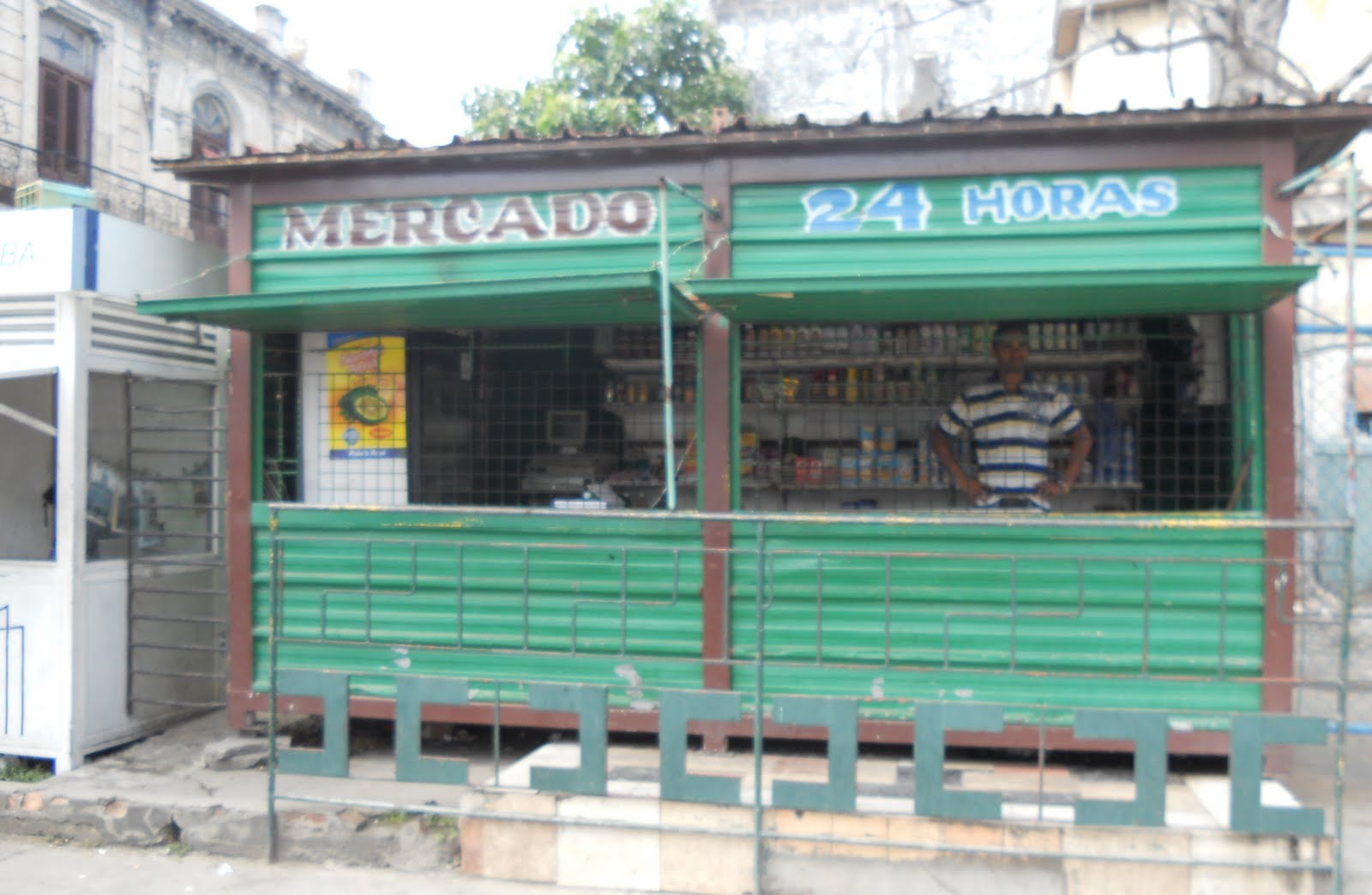
What bothered me was the pervasive feeling of economic hardship that surrounded me - but even worse, that I saw but did not experience directly. The overwhelming majority of Cubans are very poor. Poverty is their life. You see it in the food stores that you pass. There are spaces intended for commerce that are empty or nearly so.  Not because there is no demand but because there is no supply. I passed vegetable markets that had only four or five products on offer in a half empty store. Unlike here in California, where our winter fruit hails from Chile - in Cuba, if it is not local it is not available. Cuba's currency is not convertible and imported goods are not accessible to the average person.

Another  CUC  Store
They were accessible to me, however. I could have anything I wanted.  Anything, because I had CUCs.  CUCs are Cuba's tourist currency. Wherever you come from – Canada, Europe, the United States, Russia - tourists exchange their funds not into the currency used by Cubans, rather a separate currency that has its own economy, its own stores, restaurants, bars and services. In that economy, there are no shortages.  Everything is available.

The Ration Book
At my hotel, breakfast was included in the rate. By our standards, the food would be at best passable, but it was a buffet and hence it was plentiful. There was a chef manning an omelet station. Three egg, ham and cheese omelet? No problem. For Cubans, food is rationed. I was told the monthly allowance of eggs was six. Milk? After age 7 generally not available. Want more cheese in that omelet? Don't worry about what the people making it and serving it will eat.

But it is hard not to. Especially when you're confronted by the disparity and need at every turn. As you know, I wander a lot - not looking for anything, just to see what there is to see. That put me in neighborhoods tourists don't often visit. And clearly I did not look like a local. That made me a target, not of crime (though prostitution is a crime) but for commerce, or for charity.

Long lines & empty hangers
Because I wanted to learn about Cuba, I would talk (as best I could -my limited Spanish, their limited English). I heard lots of stories of hardship - some of them probably even true. Just a couple of CUCs would make a big difference to them and for me it was just the price of a beer. The CUCs open doors for them. With CUCs they can go into the stores that have everything. With CUCs they can get what they need.

But how do you get a CUC? You could rob a tourist - but I never felt at any risk in that respect - even wandering home at night down some very dark and empty streets. Tourists are the goose that lays the golden egg. Crimes against tourists would kill the industry.  The ubiquitous neighborhood CDR's (Committee for Defense of the Revolution) will not let that happen. So you have to coax the CUCs away from the tourists. Sob stories work. Mild scams (Come have a drink with us!) work. Graymarket sales (cigars, cab rides) work. But most reliable is a profession where tourists tip. Wait staff, maids, bell hops, musicians - these all see a steady stream of CUCs. You could be a doctor and earn $80 (US) a month or you could carry bags and perhaps do that in a week. What's a smart, young Cuban going to do?

Got CUCs?
I discussed this with Odalys, my tour guide. She has a daughter at university studying economics who wants to chuck it and become a tour guide, like mom. What should she do? I'm guessing tour guides do very well. Tipping is common practice and I tipped her as if I was tipping a US guide. If the other six passengers on our tour did the same, Odalys made more in tips in five days than her daughter will in a month.

It seems unsustainable. It is terribly artificial. It is creating haves and have-nots and not based on the value of contributions to Cuban society - rather on amusing tourists. It must be contributing to a pressure for change, and the government toys with modest reform. Will it be enough to head off dramatic change? Change is coming. What kind? Only time will tell.

Wednesday, February 23, 2011

Turkey: Commerce

Upscale Istanbul Mall
The point of looking at commerce in a society is that by doing so you can gain some insight into several aspects of life. The kinds of transactions people engage in and the ways they engage in them are quite revealing. In Europe (Belgium, France and Germany - all three) I was blown away by the number of Nespresso™ stores. Their prime (expensive) locations and the crowds in them to buy what is an expensive luxury. All told, it said to me: Life is good in Western Europe.

There's a lot of coffee for sale in Turkey, but not at Nespresso™ stores. Even so, I did find very high end shopping malls where just about any other thing a western consumer might want could be found. (I am sure there is a Nespresso™ store, too if you search for it). If you are looking for some international brand name item in Turkey’s major cities, it will not be hard for you to find. In a mall in Ankara they have dedicated stores for brands (Samsung, for example) that would be one product among many offered at a US department stores. The result is a selection of products more varied than might be found in the United States.
The Grand Bazaar

There's another slice Turkish to commerce besides the malls, of course and it is probably the dominant mode. At the malls, like at home, you wander until you see something that interests you, and pop in to see if you want to buy it. The retailing is pretty passive. That is not the way it is on the streets of Turkey. Now it is true that neither MC nor I look Turkish.  In fact, I expect that our appearance pretty much screamed: foreigner (read tourist) and that made us a target. (A note on MC’s appearance: Turkish women do not have gray hair. It's like a miracle of genetics - or something). Turkish shopkeepers are anything but passive. They often stand in front of their store beckoning you to come in – “Just have a look. You don't have to buy”  They are experts at starting conversations. They avoid yes/no questions, preferring “Where are you from?” They always know someone from there and you are now chatting… “Come on inside, let me show you something…”

Similar businesses tend to cluster
Another device we encountered often enough to recognize and learn to dodge is the: ‘let me give you directions’ ploy.  You can always tell a tourist by their map. Look at a map in public and you are marked. “Where do you want to go?  Why, I am just going that way myself. I'll show you.”  Somehow, your route always takes you right past the shop where they have a friend who will make a great deal for you. It may even be true, but I didn't want a carpet. We read in the guidebook that these folks work on commission and act as agents like salesmen (yes, it was only men) everywhere, they are just beating the pavement looking for customers.

Sunday, January 16, 2011

Germany: Commerce

30 years ago in Berlin, KaDeWe (Kah, Day, Vay) was the ultimate shopping experience. Even its name spoke to its special status.  It was the Kaufhaus des Westen, the West’s market. An entire city block and sixth floors of almost everything you can imagine. Even by Western standards, it was an incredible place. Before August 1961 (the building of the wall) it must've been mind-boggling for Germans living in Soviet Zone to stop in on a visit to West Berlin. The difference between what was available at KaDeWe and in the East would have been enourmous. There was a difference between KaDeWe and other stores even in West Berlin. It really was unique.

30 years later, KaDeWe is still there and it still has almost everything, but it is no longer unique. In Berlin we saw several stores that could match KaDeWe‘s inventory and even its style. It is not all that surprising. West Germany and then all of Germany has been a prosperous country
The Media Giant in the shadow of the DGR's Fernsehturm
for decades. Plenty of time for consumers to develop the demand and for retailers to respond to fill that demand. Today it is hard to imagine what might you might want that you couldn't find at your average department store, whether it be in Dresden, Munich or even a small town. A trip to KaDeWe in Berlin does not astound anymore.

Shopping in Germany was not exactly like shopping in the US, however. There was a noticeable difference in the grocery stores. It seems the German chains target market niches much more than the ones were used to in California. In our neighborhood in Berlin
You can get anything at KaDeWe
(Kreuzberg: working-class, immigrant) there were two chains near our flat. Both of them seem to be geared toward the budget end of the market. In terms of product diversity they had pretty much everything you want, but unlike Safeway, they did not have a choice in terms of quality within the product category. It was budget-brand this or budget-brand that. Not a brand-name in sight.  Not even in the important product categories where you might want a bit of luxury - like chocolate or (for Germans, gasp!) beer.

Still playing WiT9?  Racking your brain?  I bet you could use a stiff drink.  This would be your go-to guy!

Tuesday, October 5, 2010

Russia; Commerce

GUM
In Russian commercial life there is a top, there is a bottom and there is a middle.  Between the top and bottom there's a wide gulf that separates them, even if geographically they exist only a few miles from each other. This may not be unusual for a capitalist society. One thinks of Hunters Point and Union Square in San Francisco, short distance but a big difference.

For Moscow this is relatively new however. Communism was a great equalizer. Our host, Zhanna tells us about cheese in those days. Cheese was cheese. Today at the stores have dozens of varieties, for those who can afford them.
Kievskaya

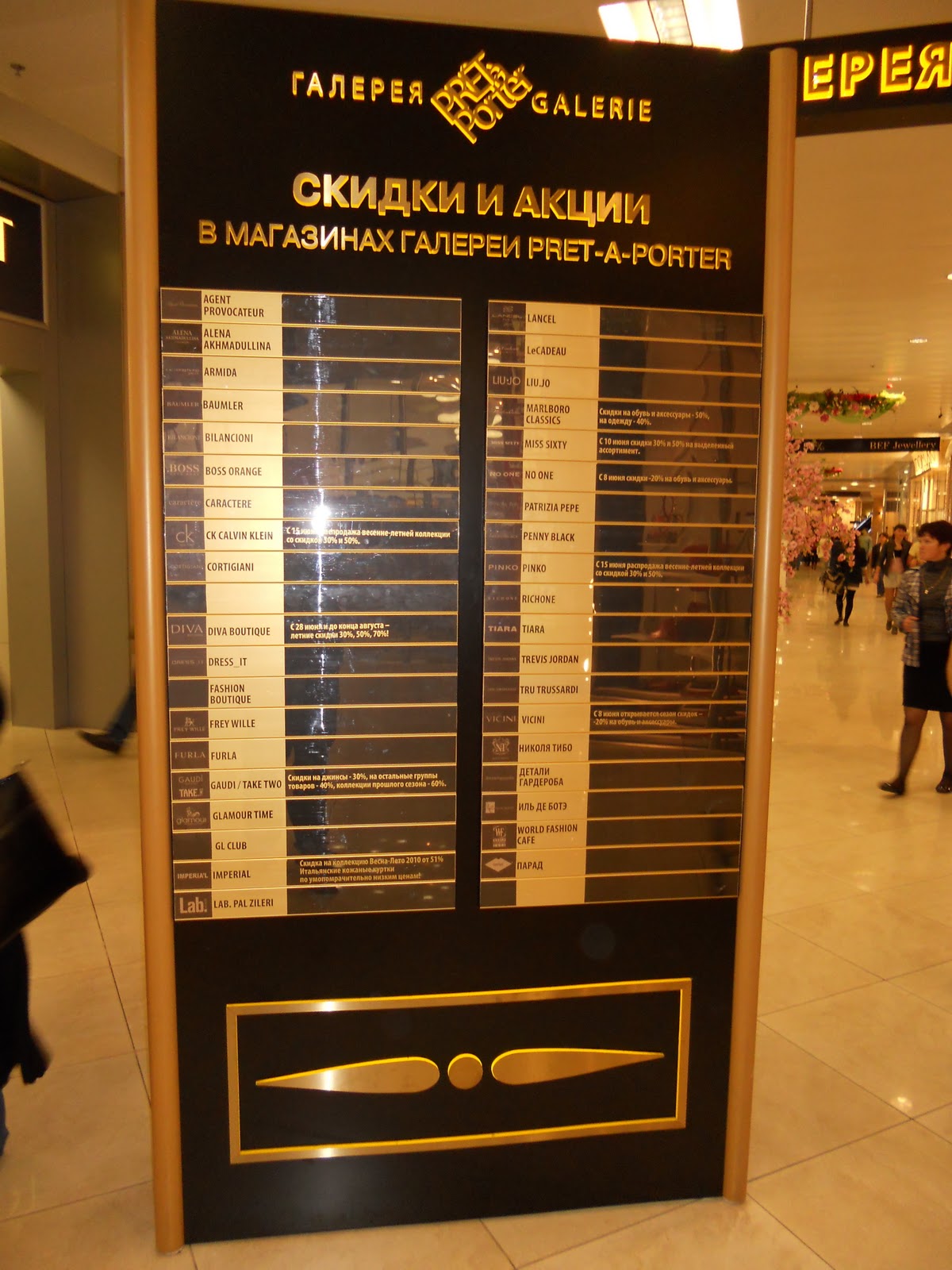
At the top of the spectrum is GUM, the iconic shopping mall across from Red Square. It is a three-story arcade filled with designer brands of the highest reputation and cost. But notably not filled with people. In fact, on a Sunday afternoon when Red Square was busy there was hardly a soul in the mall.

The bottom we found just a few steps from where we are staying, in a working-class apartment complex three metro stops from GUM.  There shops are plywood and plaster selling cheap Chinese generic products. The stalls are no more than 10 x 10 limited to one type of product. Shoes, luggage, fruit.  Is this where Moscow shops?

The Stalls
Maybe, but there is also the middle and judging by the 5 PM crowd we encountered at the Kievskaya mall, the middle may be where most Muskovites find themselves. The Kievskaya mall is new, only a couple years old, it seems. If you were dropped into it blindfolded, you would be hard pressed to know where you were. It looks very much like any suburban mall I have encountered. In fact, many of the same stores are there.

Judging from our wanderings, it seems Russians are joining global consumerism. They don't seem to be at the rampant stage at which America exists, but give them time. They seem to be trying to catch up.