Showing posts with label 2nd City Sites. Show all posts

Sunday, May 8, 2011

China 1st site, Shanghai: Yu Gardens

China in a nutshell? There's a lot going on in China. It's civilization stretches back thousands of years and those ancient influences are still seen and felt. The last century has seen tremendous upheval and many of the ancient elements were severely damaged or destroyed out right. Recently, China has regrouped and begun to renew itself. Sometimes by reconstructing what was old, sometimes by constructing something all together new. It is not unusual to see all of this in a short span of time, or distance in China and an excellent example of this is the Yu Gardens in Shanghai.

A massive complex, covering an entire city block in the old city, Yu gardens has everything. It's most impressive structures date from the Ming Dynasty, more than 600 years ago. It contains an ancient religious center, shut down during the Cultural Revolution, reopened as a jewelry store, now restored to its religious purposes. At its center is a classic example of a Ming garden with water features, sculptures and a teahouse. It could be a place of great serenity except for the massive crowds with which you are sharing the space. Those crowds are not attracted only by the Gardens ancient beauty.  No, built into the complex and occupying every square meter surrounding it, you will find an enormous bazaar, offering almost anything you can imagine buying in China.

Want classic Chinese art? It's there. Want a T-shirt of Obama dressed as Mao? It's there. From the exquisite to the tacky you can find it at Yu Gardens and when you are feeling peckish they have that covered as well.  There is a buffet with what must have been more than 100 choices (all Chinese) or nearby, street food if you dare. It was all there - a microcosm of China.

China 2nd site: Nanjing

Presidential Palace. Zhongshan Mountain Park, tomb of Zhu Yuanzhang, first Emperor of the Ming Dynasty. 

Okay, quibbler's. I will concede that Nanjing is not Shanghai, but for us it was part of our visit to Shanghai. Nanjing is, of course, an important city in its own right. Historically, it is much more important than Shanghai. In China's past Nanjing was the southern capital and hence, for centuries it was the Imperial and then the Republican seat of power. As a result Nanjing retains the artifacts of this glorious past.

RoC flag.  Banned in most places
The first that we visited was the Presidential Palace. The space, originally built for imperial purposes, was the site of Sun Yat-sen's inauguration in 1911 at the beginning of the republican era. That era was as short-lived as it was chaotic and so the buildings significance is perhaps more symbolic than historic. Nonetheless it is a monument to China's ‘intervening era’ between the emperor and communism. It was a surprise to me to see the prominence afforded Chang Kai-shek, the Communists archrival in the 50s, 60s and 70s. From Taiwan (RoC), he claimed sovereignty over all of China. Today, Taiwan and China get along much better, so I guess it's okay to allow that he might have made some contribution to China's independence.

Nanjing’s other important historic site reflects its other moment of glory - when the city was the emperor’s home. The Ming Dynasty's first Emperor built his mausoleum into the hills surrounding the city. For me it was my first experience of the scale on which the emperors operated. After Xi’an and Beijing's Forbidden City that scale may be commonplace, but the first time you see it, it blows you away. Walls dozens of feet high and wide and entry ways, hundreds of feet long with dozens of larger-than-life statues. Temples built for a single person. Nothing is done to what I would call a ‘human scale’. The expense, the manpower, the desire/need to impress - all extraordinary and then, all repeated by the next guy…

Wednesday, April 20, 2011

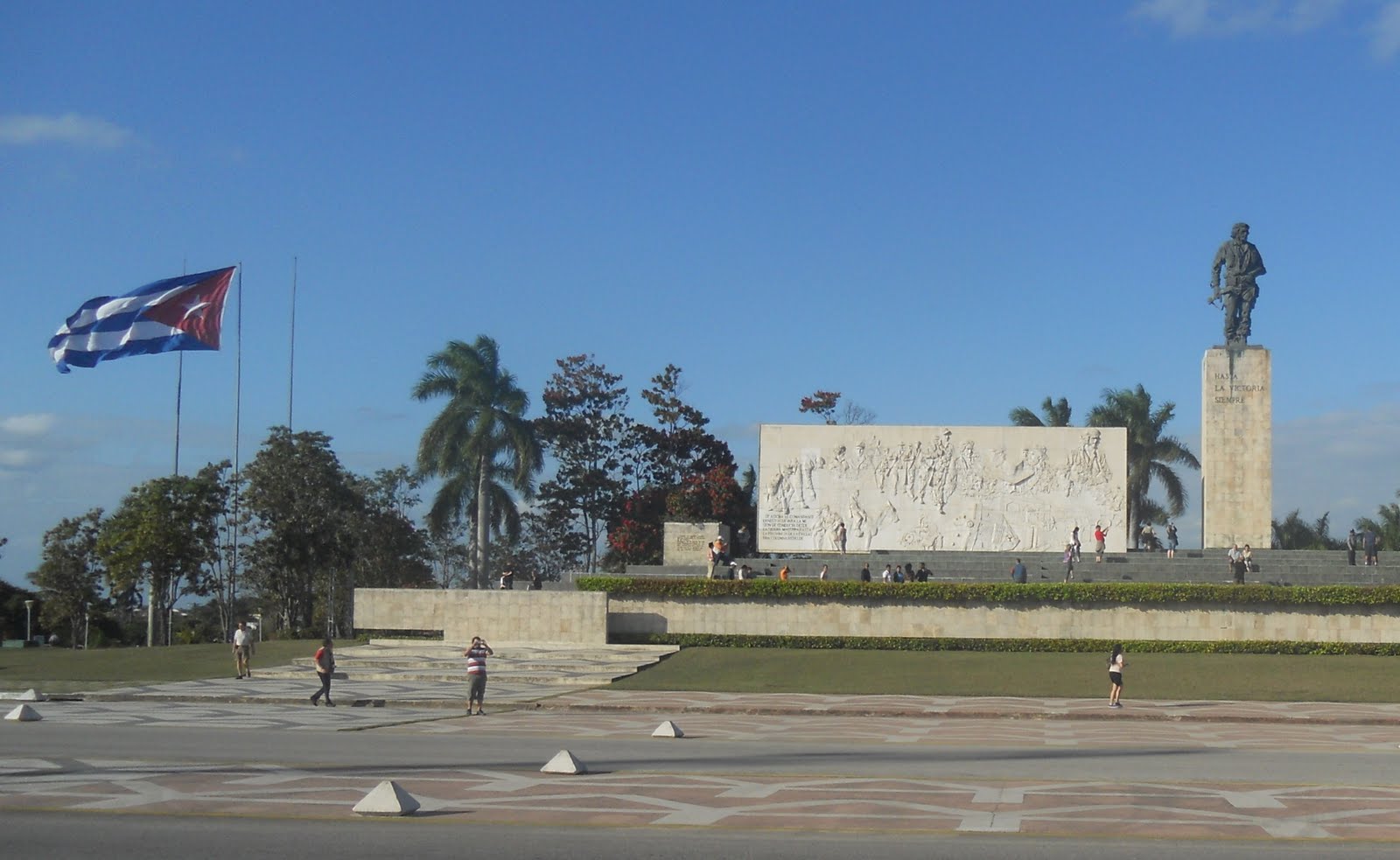
Cuba, Second site: Mausoleum of Ché

Lenin, Napoleon, Ataturk, Mao, Jefferson - I've seen the final resting place of a bunch of important historic figures.  The treatment of the body always seems to be a function of the utility of the person to the government of the day. That said, it should not surprise anyone that Ché’s final resting place would be a big deal in Cuba.

Ché is a big deal in Cuba. He is the embodiment of the revolution, its history, its ideals, its future (or so they hope). The image of Ché is ubiquitous, rivaled only by the figure of José Marti and of the two, it appears that Ché is by far the more useful. Marti is a quiet presence, meant to connect the revolution to its past. Ché is an activist, even in death, exhorting Cuba and down trodden people everywhere to engage in endless struggle against… - whatever we are struggling against today.

Your Ché Store
Ché really is the perfect revolutionary icon. He is extraordinarily charismatic - a quality that literally jumps off the page at you, not only in that extraordinary and literally world-famous Korda photo but in countless others seen in all corners of Cuban society. Ché makes the guerilla look cool. But he had more than image - he had rhetoric also “Hasta la Victoria Siempre!”  (until victory always) an inspirational catchphrase backed up with speeches and books. And he walked the walk.  As Minister of Industry, he rolled up his sleeves to do manual labor, he left the comfort and safety of government to lead insurrections in Africa and ultimately, where he died with his boots on, in Bolivia.

And that last bit is no doubt the cherry on top for Cuba's current regime. He's a martyr and martyrs do not criticize current policies. You can say “it's what Ché would want” without fear of contradiction. He's perfect.

And so of course his mausoleum is a big deal. It is in Santa Clara a provincial capital strategically located at Cuba's center. Why there? As the guidebook put it, “in a place where Ché was not born and neither lived nor died”? Santa Clara was the site of a pivotal battle in Cuba’s 1958 revolution. There, forces commanded by Ché defeated Batista's regular Army, captured important weapons and the town, which controlled a transportation hub that links North and South, East and West. After Santa Clara, the handwriting was on the wall and Batista's government collapsed quickly.

Part of the train they derailed...
Santa Clara is, then, a monument to the revolution and its military victory. It's central square contains artifacts of the battle and the Mausoleum not far away represents an important ceremonial space for annual remembrances of that victory. The mausoleum itself is remarkable and somewhat understated compared to Napoleon. It houses not just Ché but many other revolutionary martyrs and was actually built before Ché’s remains were found and were returned to Cuba. Next door is a museum dedicated to Ché’s life and work. Full of artifacts and pictures. In toto, Santa Clara has become a tourist attraction and essential part of the tour packages that divert sunseekers interested in more than just a beach. It pairs well with the commercialization of Ché’s image on T-shirts, bags - even refrigerator magnets. Somehow I doubt Ché would approve. 


Wit? Clue.  This statue was a big deal.  Big when it went in, big when it disappeared.  It's still big.

Cuba, first site: Trinidad

The goal of taking my tour of Cuba was to get outside of Havana (an urban Center, which one of five Cubans calls home) and see what life is like in the rest of the country. I am glad I did. Outside Havana, even in the larger cities, life is quite different for Cubans. It seems quieter, slower and economically less vital even than Havana - a place where frankly there was not all that much going on.

One of our stops, Trinidad, (no not the Island, rather the small south coast town) seemed to be pretty typical of life in provincial Cuba. The dominant economic activity is agriculture and much of the work you see being done relates to the care and processing of the local products. But agriculture moves in cycles. There are busy times and there are quiet times. February appeared to be a quiet time. Folks did not seem like they had a whole lot to do. Lots of people just hanging out, sitting in the streets, shooting the breeze.

There is a second economic activity in Trinidad, the one that brought us to town. Tourism is big there. In 1988 Trinidad was listed as a UNESCO World Heritage site. The tour books like to say the whole town is a museum and they might be right. Trinidad's glory days came (and went?) a couple centuries ago, when sugar was king and plantation owners used slavery to create great wealth and its trappings.

They built for themselves great palaces around a beautiful central square. Cuba’s economic stagnation has served Trinidad well, leaving it little changed from those glory days and ready for its new role as a ‘must see’ stop for bus tours. During our short stay, I saw bus after bus arrive, disgorge its Russian or German or Canadian tourists who wander through the cobblestone and Car-less streets enjoying the views, but seeing nothing in particular. The town and its ambience is the attraction.

It's not that there's nothing else to do there. There was a nice old church with wooden carved altars brought at great expense from Europe.  And the museum in the building next door, the Brunet Palace, houses an extraordinary collection of colonial finery. A grand building, it was outfitted with even grander furnishings creating a stark contrast between the way the sugar barons lived and the reality of working people - either then or now.

It made me wonder what I was supposed to be thinking. Should I admire the beauty of their things or despise them for the exploitation required to afford those things? I think I know the answer Cuba had in mind - but for me it was a little of both.

Saturday, February 5, 2011

Istanbul, 2nd site: The Sultan’s Palaces

Topkapi's Gate
If you just visit Istanbul and someone asks you if you would like to visit the Sultans’ Palace, the first thing you need to decide is, which one. I guess it should not come as a great surprise that the absolute rulers of a large and wealthy empire would have multiple residences at their disposal. Heck, even the Belgian king has more than one.
And so, yes, in Istanbul you have your choice of palaces - each one perhaps more extraordinary than the next. We visited two of the three I know of (there could be others, who knows) and even at that we have heard we skipped the best (Yildiz). 
The Harem in Topkapi
The ones we visited; Dolmabahçe and Topkapi.


In describing them, it is difficult to know where to begin. Both complexes are absolutely massive. For the Sultans, the palace was not just a place for the family to live. Well, not the family the way we think of a family, in any case.

The Sultans entourage was bigger than most royal families. It included, of course, the famous Harem, which turns out to be not as wild as your fantasies might imagine - but still represents a sizable enterprise, nonetheless.

The Harem did house the women who would be in the Sultan’s life, but it was nothing like an exclusive brothel. More like a girls school. Before a woman was ever introduced to the Sultan she needed years of formation. The Harem organized and delivered that. It needed a huge staff to accomplish this and that meant the palace needed to provide  that infrastructure.

The palace also had to provide for the government. The Sultan and his advisers needed a place to work and of course, it needed to provide suitable security. The Topkapi Palace is essentially a walled city, with everything you can imagine needing behind those walls and delivered in the style suitable for a sultan.

Dolmabahçe, my one picture
And then, if anything Dolmabahçe outdoes it. Topkapi maybe more impressive because of its age and the craftsmanship of its period (the 15th C) but Dolmabahçe is bigger and by far more opulent, reflecting the tastes and desires of more modern monarchs. Built in the mid 19th century, it reflects the fashions of the era (no pictures allowed, I only got one before we got caught). It may be the largest and most opulent palace we visited on this trip, and we visited a bunch! It has an exterior that rivals its interior. Set on the shores of the Bosporus, it is truly stunning. It makes you wonder why someone would abandon it and build a new one (Yildiz Palace).

The View from Dolmabahçe
As it turns out, Abdul Hamed II was convinced that the lovely Bosporous setting was a liability. He was convinced it was vulnerable to attack and wanted someplace safer. Paranoid? Well, as they used to say in the 70s “it ain't paranoia if they really are out to get you!” Abdul Hamed II was the last Sultan. Dolmabahçe was taken by Atatürk and his revolution. It became the new government’s Istanbul headquarters and was the place where Atatürk spent his dying days.

Friday, February 4, 2011

Istanbul, 1st site: Hagia Sophia and Blue Mosque.

Not the effect the Sultan was aiming for
It is somewhat ironic that the old city of Istanbul is so thoroughly dominated by monumental religious structures, the Hagia Sophia and the Sultan Ahmed (a.k.a. Blue) Mosque. It is ironic because although the space is consumed by these structures, the religiosity does not seem to extend beyond a visual façade.


The Blue Mosque
Literally within a few meters of each other lie a building intended as a showpiece of Christianity and its counterpart the Blue Mosque designed to reflect the Sultan’s perspective of the superiority of his empire and his religion over the relics of the old Byzantine order

Both buildings are truly impressive in scope. The Blue Mosque has a reported capacity of 10,000 worshipers and the Hagia Sophia is actually the larger of the two structures. The Blue Mosque, built on the ruins of the old Byzantine emperor’s Palace, is perceived to rise above the Hagia Sophia. This was the desired effect. Though it doesn't look like it, the mosque, benefits from a slightly higher elevation. The interior of the Blue Mosque is dominated by thousands of ceramic tiles, blue in color, which give the mosque its name. It's interior would dwarf any interior space except perhaps a modern sporting venue or, of course, that of its neighbor - ‘the church across the street’.

Hagia Sopia
That church across the street is, of course, no longer a church. It sceased to be that with the Ottoman conquest of Constantinople (Istanbul) in 1453. For the next (nearly) 500 years, it was one of Islam's most important mosques - until the Turkish republic. In 1935 Ataturk made it a museum - what it is today. A secular space.

And the ‘mosque across the street’? Though still used as a place of worship, I'd wager it sees more tourist visitors than worshipers in the course of the year. The Blue Mosque, like Notre Dame in Paris, is more of a tourist attraction than anything else. The imposing religious site has been overtaken by the secular world and its economic pursuits.

Playing WiT?  Here's a clue:  Forget Jean Monnet - the EU was this guy's idea.  He just had different methods.

Tuesday, January 25, 2011

Germany: Dresden traces of the GDR

When trying to decide where we should go in Germany to get that second look I need for comparison, the decision was not really all that hard. I was anxious to see what had happened over the last 20 years in the old east Germany. In Dresden I would have some basis for comparison, having visited the city in 1979.  A hint of some of the changes we would see, we had already had in Berlin. Half of that city had been in the GDR, but it would take a pretty keen eye to be able to visually distinguish between Berlin neighborhoods today. There really is not much difference between East and West Berlin.

In Dresden, the changes have been a bit slower in coming. As you know from previous posts, there has been a lot of reconstruction of the historic buildings.  That part of town looks more like 1890 than 1990 (the year the wall came down). In the other parts of town the legacy of the GDR is not fading so rapidly into the past. In many parts of the city you still find the excessively wide streets that have far more capacity than is needed for current traffic loads, but were needed for May Day tank parades. It appears that the bulk of the residents still live in the massive block structure apartment complexes preferred for both economic and ideological reasons throughout the Soviet bloc.

If you remember, when we were in Moscow we stayed in just such a building. You can cram a bunch of people into a small space, but it creates an odd cityscape. Huge buildings separated by huge empty spaces. Possible only where land has little value and people have little choice.

Slowly, it seems some of these structures are coming down and being redeveloped but it is a slow process. Kind of like the Socialist mural on the side of the city's theater complex, it seems they are allowing the old GDR to fade away slowly on its own through benign neglect. Someday, when it gets bad enough they will replace it.

Saturday, January 22, 2011

Germany: Dresden and the Frauenkirche

WiT?  J-K ;-)
Standing in the square in front of the Frauenkirche is a statue of Martin Luther, the survivor. That statue was a part of the church which like almost everything else, was destroyed in the 1945 bombing. The statute remains and was moved to the square - standing watch over a pile of rubble that once was a church described as the protestant’s St. Peter's.

In its day, the Frauenkirche had been a center of Protestant theology and a showpiece, boasting the largest dome north of the Alps – in other words, in the Protestant world. It was a glorious structure and an impressive display of engineering know how. It said to the Catholic world “we are your equal”

And of course, in the bombing, it all came crashing down. The initial response of Dresdeners was to rebuild it. The preference of the East German communists was to leave it as it was - the ruins being a reminder of the consequences of war. The symbolism of Luther’s church lying in ruins was also no doubt appealing to the GDR's official atheists.

And so for decades that is how it sat. That is how we saw it in 1979. A pile of rubble. In 1990, with the Communists now lying in the ash bin of history, Dresdeners once again raised the idea of reconstruction. They put out an international appeal for aid ($) and their call was answered. Locally, the rebuilding sparked some controversy. Some felt preserving the ruin, like the Berlin Gedächniskirche, was required to preserve the memory of the destructiveness of war. The church community's response was to build the memorial into the reconstruction itself. Whenever possible, the original bricks were used and where they were used they bear the marks of the bombing. Those black stones contrast with the new Sandstone and send a powerful message. It is a message you see communicated almost where ever you look in the old city. Why are those buildings so black? War.

Playing WiT?  There's a new clue...

Tuesday, October 5, 2010

Russia; St. Petersburg - The Church of Spilled Blood.

When one thinks of iconic Russian churches with the classic, brightly colored onion domes, one tends to think of St. Basil's on Red Square in Moscow. St. Petersburg is not to be outdone, however. They have a church which is every bit as spectacular as St. Basil's. In fact it may be more beautiful. It is called the Church of Spilled Blood.

It has a real name, the Church of the Resurrection of Christ, but its existence is owed to the fact of spilled blood. It's not really a church it seems. The guidebook says it has never been used for services. It was built as a shrine to the memory of Alexander II.  The Czar was assassinated in 1881.  The spot on which he was killed is preserved as it was when he was killed. The streets cobble stones are there, over which a small shrine was built, then surrounded by the massive shine which is the church. The church itself is an intricate work of art.

Inside the decoration is mainly mosaics. As is typical of churches of this period, the mosaics depict the saints and the gospel. These mosaics climb the walls and in the dome is a massive Christ looking down on you. The alter is another typical yet exquisite example of Russian orthodox iconography. It is a fantastic setting. It is astonishing that it would be built with such care and expense and then not used. In fact it may have had more use during the Soviet era when it was a museum of atheism or during the siege of Leningrad, when it was used to store potatoes. Today it sees a steady stream of tourists and brides. Wedding parties use its exteriors for photo shoots. Another interesting note, surrounding the exterior of the church are a series of plaques commemorating Alexander II’s rule and his many accomplishments. They are notable. He was a progressive ruler by Russian standards. It is ironic that his attempt at progress were not enough for his enemies to choose to spare him.

Tuesday, September 21, 2010

Russia; St. Petersburg - The Hermitage Museum

Is the Hermitage the world's greatest museum? I had heard people make that statement, but I have never really given it much credence. Seriously, how could it be? The Louvre has the advantage being the home country of so many of the world's great artists, how could the Hermitage be better? I was skeptical, especially since only days earlier I had been in another of the world's great museums, the British Museum.

The overriding impression I always have at the British Museum is; "Wow, having a global empire sure gives you the chance to steal some cool stuff!"  The Brits have treasures from everywhere. The Russians never really had a global empire, how can their treasure trove ever compare?  Yet it does.

The Hermitage is amazing, not only for its quality but also for its size and scope of its collection. The guide says that its collection contains more than 3 million objects. What they display is contained in more than 300 rooms. It is truly a massive collection.  Contained in the collection are some amazing pieces. Having been to the Vatican I have seen Roman statuary -  but not pieces in a condition as good as the Hermitage. Fingers! The statues still have their fingers! And the paintings, room after room of the Masters. It is an all inspiring collection.

When you recover, you begin to think about what it means. 300 rooms, many of which were worth seeing even if they have not been stuffed with art. A palace whose scale makes Versailles seems small. Palaces do not appear magically. They are the product of wealth and power. The Hermitage and the Winter Palace are testimony to the enormous wealth and power of Russia's Czars. The art that fills them is the legacy of a ruling class that extracted great wealth from its country and its people. Maybe in the palace you can see the revolution coming?